
 WRITTEN BY TILLIE NELSON
Every month a brand tells us they have “done TikTok Shop” because a shop exists, or “tried live” because someone went live twice. Both are channels. Neither is a strategy. The results everyone screenshots come from somewhere else: the whole ecosystem running as one machine.
The parts, and why each one starves alone
Creator commerce on TikTok has five working parts. Each one underperforms in isolation, and each one feeds the others when connected.
- The shop. Entity setup, a clean catalogue, compliant listings, shop SEO. Unglamorous, and the foundation of everything, because every video and live in the system sells through these listings. A weak listing taxes the entire machine.
- Shoppable content. Short video built to convert mid-scroll, not brand film. On its own it produces a trickle of sales. Its real job is bigger: it preheats launches and lives, and it becomes the creative inventory your ads run on.
- The creator salesforce. Affiliates who make content and take a commission. Run as a programme, recruitment, samples, training, activation, they are distribution you do not have to schedule. We run these programmes, and we are affiliates ourselves: everyone at Novaro sells on TikTok Shop every week.
- Live. The pressure point. Live is where an audience that content warmed up actually converts, at rates nothing else on the platform touches.
- Paid amplification. TikTok’s GMV Max multiplies whatever already converts, videos, listings and live rooms alike, against a target return. Pointed at a healthy system it compounds it. Pointed at a hollow one it just finds the ceiling faster.
What it looks like when the parts connect
The Brontë microwave launch is the cleanest proof we can publish. A brand-new product, no retail distribution, launched as a TikTok exclusive. The ecosystem ran in sequence: the shop was built clean, the affiliate roster seeded content for four weeks, the drop landed with real scarcity, and three produced live streams anchored the launch night.
Pull any one part out and the number collapses. Without the preheat, the lives open to an empty room. Without the lives, the warmed audience has no moment to convert in: the three streams took 61% of everything sold. Without the shop foundations, none of it transacts. The channel did not produce that result. The system did.
The same logic, week in, week out
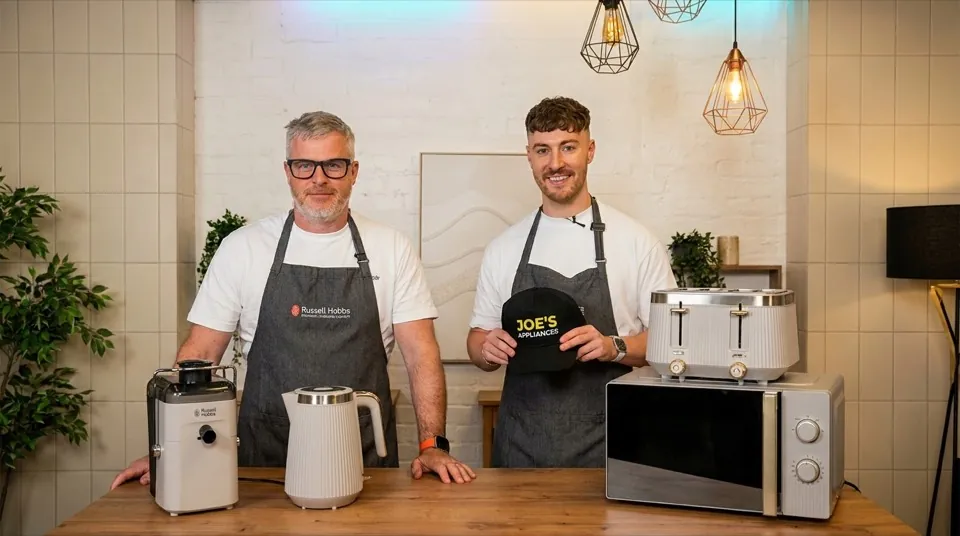
Launches are the dramatic version. The compounding version is a channel run like a broadcaster: a weekly live schedule, content preheating every show, affiliates selling between shows, ads amplifying all of it. That operating rhythm is what took the Russell Hobbs shop we manage to $2.8M in GMV, up 164% year on year, with over $130K of it from brand lives.
One show, every audience
An ecosystem also should not end at one app. Through our Sprii partnership, a single produced show broadcasts simultaneously to TikTok, Facebook, Instagram and the brand’s own website. The production cost is identical. The strategy question stops being “which platform” and becomes “how many rooms can this show sell in at once”.
Where to start if you own a channel today
You do not build all five parts at once, you build them in the order that feeds the next. Get the shop genuinely clean first, because everything else transacts through it. Then stand up a steady flow of shoppable content, even a modest one. Recruit and sample your first affiliates so content starts arriving that you did not make. Only then commit to a live schedule, because now there is an audience being warmed and creators to front shows. Ads come last, once there is something worth multiplying. Most brands run this order backwards, buy traffic into a hollow system, and conclude the platform does not work.
How to tell which one you have
Ask three questions of your current setup. Does your content calendar exist to feed your live schedule, or do they run separately? Do creators sell your product without you booking each post? Does your ad spend draw on creator and shop content, or on assets made just for ads? Three yeses is an ecosystem. Anything less is a channel, and channels plateau.
Building the whole system is genuinely more work than opening a channel, which is why most brands do not do it, and why the ones that do stand out so sharply. It is also why we built Novaro as operators: studios, presenters, creator programmes, shop management and ads under one roof, run for brands rather than advised at them.