
 WRITTEN BY TILLIE NELSON
We produce live commerce in our own Manchester studios every week, and everyone at Novaro sells on TikTok Shop as an affiliate, including the studio manager. This is what actually moves the number on a live, from the people who run them.
1. Sell before you go live
The biggest lever on a live happens before the camera turns on. Shoppable content posted in the days before a show does the introducing: the product in use, the offer trailed, the date seeded. When the Brontë microwave launched, the preheat ran for four weeks before anyone went live. By launch night the audience was not discovering the product, it was waiting for it.
2. Build a run-of-show, then obey it
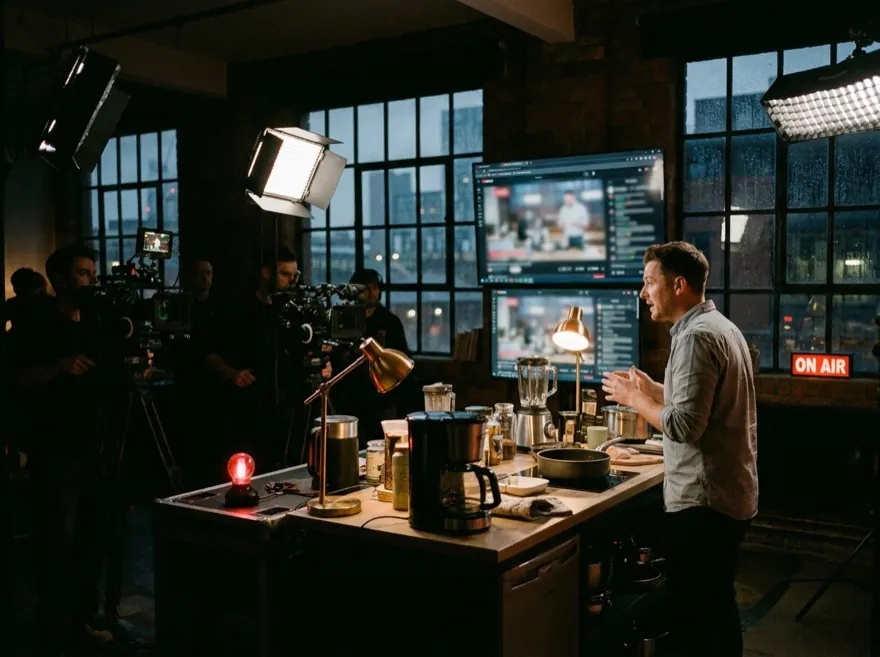
A converting live is a produced broadcast, not a long unplanned video. Ours run to a written rundown: segments with times against them, one hero product per segment, offer beats planned, demos rehearsed. Energy up front, numbers underneath. Wandering streams leak viewers, and viewers who leave do not buy.
3. The presenter is the conversion rate
The single biggest variable between two lives with the same product is the person holding it. Presenters who can demo, react to comments and land an offer without breaking stride are trained, not found. It is why we run presenter development in our studios, and why the strongest stream of the Brontë launch was fronted by a creator, JimboNRobbo, whose one show did $65,036.
4. Make the offer only make sense now
Live converts when the moment matters. Vouchers that expire with the stream, bundles built for the show, stock levels said out loud. It has to be true: the Brontë drop sold its first 1,000 units in 32 minutes and then actually sold out. The audience learns very quickly whether your urgency is real, and treats every future show accordingly.
5. Work the comments like a shop floor
Comments are buying signals. Answer the sizing question in seconds, pin the product being asked about, greet returning viewers by name. A moderated, worked comment rail keeps people in the room, and time in the room is the strongest predictor of a sale. This is a staffed job on every broadcast we run, not a nice-to-have.
6. Treat live as a schedule, not a stunt
One-off lives leave money on the table because audiences cannot form a habit around them. The shops we grow broadcast like channels: same days, same faces, formats that repeat. That is how the Russell Hobbs channel we operate compounded to $2.8M managed GMV, up 164% year on year. The exception proves the rule: even a launch spike is really a schedule compressed, three planned streams inside 48 hours, not one long one.
7. Point paid traffic at the room
TikTok’s GMV Max can push likely buyers into a live while it runs. If the show is converting, paid pours fuel on it; if the show is flat, paid just proves it faster. Get the production right first, then let the ads multiply it.
8. Broadcast wider than one platform
Through our Sprii partnership, one show can go out simultaneously on TikTok, Facebook, Instagram and the client’s own website. Same studio, same presenter, every audience at once. If you are already paying for the production hour, this is the cheapest reach you will ever add.
9. Review every show like game tape
The lives that compound are the ones that get reviewed. After every broadcast we read the numbers per stream, not per week: revenue, units, viewers, and where in the rundown they spiked or leaked. On the Brontë launch that discipline is why we can say exactly what each show did, $65,036 and 546 units for the strongest, $46,571 and 390 units for the next, $39,555 and 341 for the third. When you know which segment sold and which stalled, the next run-of-show writes itself. Shows that are never measured never improve, they just repeat.
What it adds up to
On the Brontë launch, three live streams produced 61% of everything sold, $151,163 of a $246,645 48-hour total. Live is not a side channel on TikTok Shop. Run properly, it is the pressure point where the whole system converts.